Hey everybody!
It's been a couple of busy weeks here in Pittsburgh. I've been up to my neck in school work while settling into the new city. I'm having a real blast, but it is a truly exhausting experience. (Anyone that follow my twitter: I'm sorry. I'm so sorry.) Between all of the work and balancing socialization time, I've been teetering in my usual emotional levels of "Everything is amazing!" to "What in the world am I doing with my life!?" I have been assured that this is a completely normal human response and that it will level out fairly soon.
I've started fencing again so that I can keep my skills from completely rusting away. I found some people to swing swords at and carpool, so I've got some motivation, though I made the distinct tactical error of forgetting my electric equipment back in the lovely state of Michigan. Of course this means I will have to recover it before I can even think about becoming more competitive. This also involves having free time to actually travel to tournaments, and since I currently lack anything that amounts to free time or spare cash, this could be regarded as a positive problem.
(On a side note, it doesn't appear that the state of Pennsylvania actually uses the AskFred database. That means that I have no idea about what sorts of tournaments and ratings are doing around here, which is quite aggravating.)
As far as writing goes, I've gotten a couple of rejections for some stories (which is still promising) and a possible novel outline to completely ignore during my first draft. I'm mostly putting my stuff on the back burner until I can get some solid classwork footing. Possibly jumping into Nanowrimo if everything seems to in good shape. I've only got a month to work myself into a frenzy before that prospect becomes impossible, but it looks good in the distance.
In the "spare time" that I have left for reading, I've been working through Ted Chiang's collection of short stories "The Story of Your Life and Others" which has been an amazing read so far. The story Division by Zero was especially poignant as I'm frantically working on my proof-based math homework. If I write anything that approaches what Ted is able to do with his pieces, I will be exceedingly happy with myself. I doubt that will happen for a while, but I feel it's a good, lofty aspiration.
I've also picked up the third volume of "Locke and Key: Crown of Shadows", written by the ever talented Joe Hill. It should be noted that Gabriel Rodriguez's art is gorgeous as usual. It is an excellent continuation of the storyline and I'm really excited to see where the series is heading in future volumes.
Other than that I'm just polishing my resumé and ironing my suit for interview for possible internships this summer. It seems like all of the companies that I'm looking at are arriving on campus in the next few weeks which gives me plenty of time to panic uncontrollably. Hopefully I'm not just stuck watching Netflix and eating popcorn during a few months this summer, as appealing as that sounds. (It would let me catch up Breaking Bad though, so not an awful plan. Still not ideal.)
Oh! If you guys had science questions that you wanted answered in simple terms, feel free to aim a tweet or comment my way. I'm always happy to give my best attempt at clear answers, and as you can tell that something that I've been trying to work on for the blog.
That's about everything (minus stressing more about homework load) so mostly I just need to keep my head down and keep working. I've got a lot of good things happening, and it's nice to be doing something that I love. I'll try to update more as things go forward!
Have a great week everyone, and take some time to relax and enjoy yourself!
~ Patrick
Thursday, September 12, 2013

Monday, September 9, 2013
Stupid Simple Science: Microbes and You
As someone who studied microbiology in undergraduate, I can be a little bit dense on what the general public knows about my field. So today, I'm going to talk about the microbiome, specifically your microbiome. This is going to be the briefest touches into the complicated relationship we have with microbes and hopefully this will help you understand things a little bit better.
First off, I didn't realize how lacking this stuff was in pop consciousness. There aren't any youtube videos about this with more than 5k views, only one TED talk. The only real stuff that starts hitting the public image is probiotics (which are marginally effective at best) and honestly is putting practical application to something we don't know the intricacies of just yet. (Also to sell you pills. Don't take probiotic pills. Eat yogurt, it's cheaper. Obligatory: this is not medical advice.)
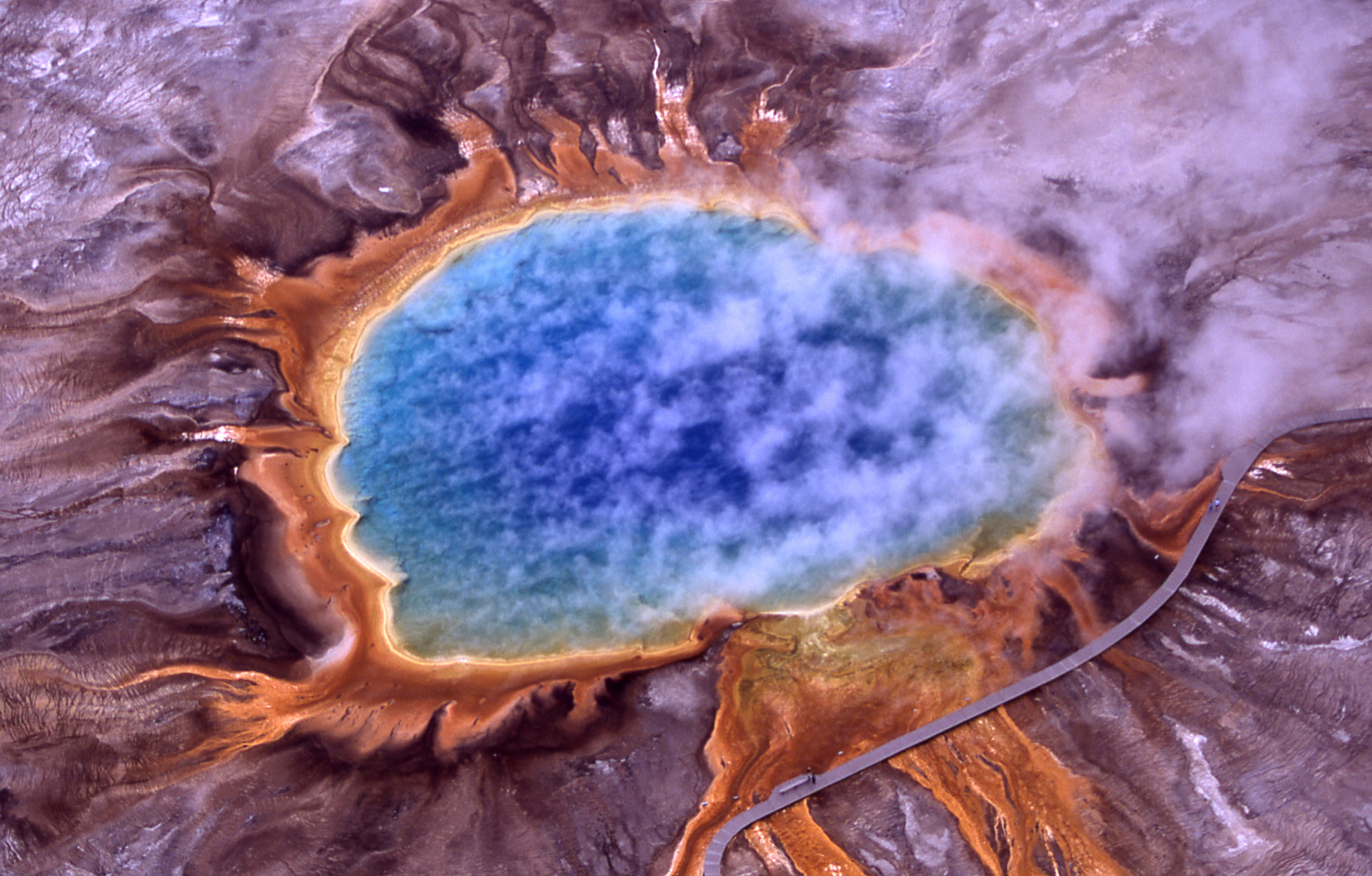 |
| Grand Prismatic Spring, Yellowstone National Park Color variation due to microbial biofilms. |
The second bit is that most scientists really don't do a good job at explaining cutting edge science for people that don't speak their sub-variant of geekenese. I'm going to try and do this justice with links and other good things. The first thing you have to know about microbes is that they are everywhere. Literally almost everywhere. Except in specifically sterile places and on molten rock surfaces, there are microbes on and in everything. Boiling pools of sulfur? Totally. Thriving in the hearts of glaciers? Of course. In solid rock miles under the earth's surface? You betcha. Six miles into the sky riding on updrafts? I'm certainly glad I'm not.
The long story short is that wherever microbes can live, they will. Some of these things eat sulfur, arsenic with a side of methane for breakfast, and others only divide once every millenia and a half. Quite a few of these things think that the conditions that humans need for life are extremely toxic (namely oxygen, but anaerobes are finicky to say the least), but there are entire communities that not only live with the same conditions that humans do, but need conditions that humans create. I'm not talking the fungi that live in dishwashers, but almost every surface of our body is completely coated in microbes.
**A quick side note: surface means "not in the body". Your intestinal tract, your sinuses, insides of your lungs, and inner ears are all outside your body as much as your skin is. (Yes they are all coated in microbes too.) Pretty much all animals that developed past sponges are roughly donut shaped with regards to body surface.**
Before you get the hand sanitizer and start dipping yourself in it, know that this is a good thing. A really good thing. All those pathogens that are constantly trying to infect you and eat you? They have to not only get past the body's defenses but also out compete an entire ecosystem of microbes that have specifically adapted to your body conditions. Not your friend's body conditions either: every person has a completely unique set of microbes and every single surface of your body has a different set of flora specifically evolved to grow there. Your skin microbes that grow on your elbows are different from those that live in your scalp, from those that live in your armpits, from your eyelids, and even your bellybutton.
They eat pretty much everything that can be eaten and actively hate on anything that is trying to make a foothold on your body that isn't already there. Now anything and everything that you touch puts new microbes on your skin and puts your skin microbes on everything that you touch. This includes other people.
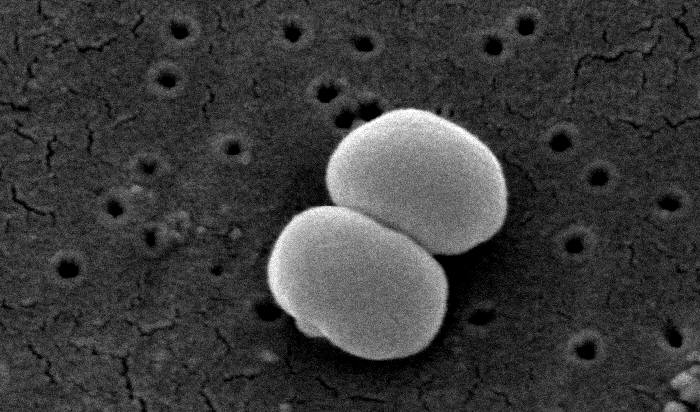 |
| Staphylococcus epidermidis, Common skin flora Scanning Electron Image |
So you have this really badass crew of microbial bodyguards on your skin. What about everywhere else? Well, we know a lot but we don't know everything. We know that your gut microflora produces vitamins (primarily K) and breaks down things that we can't normally process. Neither cows nor termites can break down cellulose in plants, but they both have closely symbiotic microbes that do that job for them. That's cool and everything, but I mean it's not like there are that many microbes on us, right? We can't even see them!
Ha. Yeah. Nope. You are only 10% Human. Out of the entire biomass that you occupy, only 1 in 10 of your cells contains your DNA sequence. The rest are many, many, many varieties of microbes each with their own set of genes, proteins, and enzymes. Your initial set of microbes is from when you are born and come into contact with your mom, and breastfeeding is shown to pass along and promote gut microflora. Everything from there is gathered as you go. If you've been somewhere once, you probably have some microbes that are unique to that exact location. Heck, if you meet someone from somewhere you've never visited, you might have picked up microbes unique to that location from them!
Every single person is completely coated in unique, human-specific organisms whose community composition dictates how we break down food, smell, develop cavities, maintain clear skin, derive nutrients, avoid infections, and much more that is still being discovered. Trying to get rid of them is pointless and ultimately harmful.
Also, please wash your hands: they are really disgusting.
Thursday, August 29, 2013
Stupid Simple Science: Eyes
@FocusSwordsman Why do most complex organisms only have two eyes, and only in the front?
That is a very good question. I'm going to avoid taking the microbiologist answer of "because multicellular animals are weird" and try to give some good concepts. We'll break this down into a few different questions and I'll try to explain the ideas behind each.
Why eyes to begin with?
Eyes are really important for most organisms, but almost none so much as humans. Our eyes give not only light input, but also allow us to interact socially and detail written information and so such humanities nonsense. We think of them as all important, whereas a dog might sooner go blind that lose its sense of smell.
Why do we use light for one our senses? Above water, it travels farther and faster than sound, pressure, heat, and molecular diffusion (smell/taste) and it allows us to perceive minute chemical differences in materials without ingesting them. (There are lots of chemicals that have colors outside of our range of vision, then tend to show up white or clear depending on their state.) This means that we have access to information more quickly and at a greater distance than any of our other senses.
Why in the front though?
Most animals have optic sensors near their brains to allow for optimal reaction speed. There is a maximum speed that your nerves can transmit information at, and in order stay relevant to something that is moving at the speed of light, they have to be as close to the brain as possible.
Human nerves can transmit information from 30-120 meters per second. [Bullock, H, (1965), Structure and Function in the Nervous Systems of Invertebrates], compared to light's blisteringly fast 299,792,458 meters per second [google.com].
This means that any eyes that aren't optimally close to the brain are going to suffer from some serious lag in responsiveness. Well, more so than we suffer from already. Brains, for whatever reason, are usually situated in the front of the organism.
Why multiple eyes?
Ok, so being able to see and interpret light is a good thing. So why in the world do we have more than one? It's not like we are going to be able to react soon enough to quick light stimuli with our signals to our muscles creeping along at a mere 120 m/s (which is a cool 268.432 mph for our imperial friends) so why do we need the same input multiple times? Well, it's not the same input exactly.
You've heard this before, as humans have excellent depth perception being hunters, but the slight difference in the image produced by two eyes that close to each other allows our fantastically bored brains to infer the difference in distance of multiple objects. This is primarily hunters though, as most herbivores have shifted their eyes to the sides of their heads to create a much larger field of vision but at the price of their depth perception.
The reason for multiple eyes is generally to create better depth perception or to increase range of vision. Outside of that there is little reason to generate new eyes, (though the infrared sensors in snakes could technically be considered eyes as they interpret a specific set of low wavelength radiation. I'm not a herpetologist though.)
Ok, but why two?
Two eyes? Oh, right. That thing that happens in most mammals, reptiles, amphibians, fish, birds, and almost everything with a vertebra. The first things with vertebras probably developed two eyes (because of bilateral symmetry) and then went "Guys! This is in 3D!" and didn't move on from there. Pretty much what they movie industry has been doing for a while now. (You think they would just get over it.)
That is a very good question. I'm going to avoid taking the microbiologist answer of "because multicellular animals are weird" and try to give some good concepts. We'll break this down into a few different questions and I'll try to explain the ideas behind each.
Why eyes to begin with?
Eyes are really important for most organisms, but almost none so much as humans. Our eyes give not only light input, but also allow us to interact socially and detail written information and so such humanities nonsense. We think of them as all important, whereas a dog might sooner go blind that lose its sense of smell.
Why do we use light for one our senses? Above water, it travels farther and faster than sound, pressure, heat, and molecular diffusion (smell/taste) and it allows us to perceive minute chemical differences in materials without ingesting them. (There are lots of chemicals that have colors outside of our range of vision, then tend to show up white or clear depending on their state.) This means that we have access to information more quickly and at a greater distance than any of our other senses.
Why in the front though?
Most animals have optic sensors near their brains to allow for optimal reaction speed. There is a maximum speed that your nerves can transmit information at, and in order stay relevant to something that is moving at the speed of light, they have to be as close to the brain as possible.
Human nerves can transmit information from 30-120 meters per second. [Bullock, H, (1965), Structure and Function in the Nervous Systems of Invertebrates], compared to light's blisteringly fast 299,792,458 meters per second [google.com].
This means that any eyes that aren't optimally close to the brain are going to suffer from some serious lag in responsiveness. Well, more so than we suffer from already. Brains, for whatever reason, are usually situated in the front of the organism.
Why multiple eyes?
Ok, so being able to see and interpret light is a good thing. So why in the world do we have more than one? It's not like we are going to be able to react soon enough to quick light stimuli with our signals to our muscles creeping along at a mere 120 m/s (which is a cool 268.432 mph for our imperial friends) so why do we need the same input multiple times? Well, it's not the same input exactly.
You've heard this before, as humans have excellent depth perception being hunters, but the slight difference in the image produced by two eyes that close to each other allows our fantastically bored brains to infer the difference in distance of multiple objects. This is primarily hunters though, as most herbivores have shifted their eyes to the sides of their heads to create a much larger field of vision but at the price of their depth perception.
The reason for multiple eyes is generally to create better depth perception or to increase range of vision. Outside of that there is little reason to generate new eyes, (though the infrared sensors in snakes could technically be considered eyes as they interpret a specific set of low wavelength radiation. I'm not a herpetologist though.)
Ok, but why two?
Two eyes? Oh, right. That thing that happens in most mammals, reptiles, amphibians, fish, birds, and almost everything with a vertebra. The first things with vertebras probably developed two eyes (because of bilateral symmetry) and then went "Guys! This is in 3D!" and didn't move on from there. Pretty much what they movie industry has been doing for a while now. (You think they would just get over it.)
Monday, August 19, 2013
Stupid Simple Science: Species
In an effort to reach out to the general public, I'm going to tackle one of my favorite subjects: the concept of Species. Most people outside the field of biology don't realize that this isn't some dry definition in a textbook, but is one of the more debated definitions in the field and changes wildly on context. I'll get started with the macro-biology term (where things make a little sense) and then move into the real fun stuff.
(I'm going to warn you ahead of time that this doesn't have a cut and dry answer, and I'm touching on very few of the big complex arguments and am doing none of them justice. So please excuse me as I butcher these arguments and examples. Feel free to ask any questions. I will try to clarify further.)
(Also, I'm going to do a lot of linking to Wikipedia. Bear with me please, none of the links are really necessary outside of providing easy routes for further research on your behalf.)
Species: A Definition
"The major subdivision of genus or subgenus, regarded as the basic category of biological classification, composed of related individuals that resemble one another, are able to breed amongst themselves, but are not able to breed with members of another species."
(I'm going to warn you ahead of time that this doesn't have a cut and dry answer, and I'm touching on very few of the big complex arguments and am doing none of them justice. So please excuse me as I butcher these arguments and examples. Feel free to ask any questions. I will try to clarify further.)
(Also, I'm going to do a lot of linking to Wikipedia. Bear with me please, none of the links are really necessary outside of providing easy routes for further research on your behalf.)
Species: A Definition
~ Dictionary.com (Not filling space or anything)
So basically a species is a group of organisms that can breed within themselves to produce offspring that can also reproduce. That sounds simple, right? It's not though.
There are three major criteria for what can and can't breed. First off, if two organisms do not have functioning biological that connect properly (Tab A into Slot B and all that jazz) then they aren't the same species because they cannot physically mate. A Tree and a Duck for instance. Literally two different pieces of equipment.
Second off, if two organisms could breed but cannot genetically produce viable offspring, then they aren't the same species because their genes are incompatible. Donkey and Horse producing a Mule are a good example. Mules can't breed further, and are sterile therefore ending the line.
Finally, even if two organisms can produce viable offspring but never encounter each other in nature because of basic behavioural or geographic differences, they are considered separate species. Nocturnal versus Diurnal animals for instance. Also geographic isolation can cause a speciation event if enough difference is generated for one of the first two criteria to take place before they are rejoined.
You got that? It's pretty straightforward. Two organisms fit into the same species if they mechanically, genetically, and temporally interact in order to generate more organisms that can also do the same. Really cut and dry. Absolutely nothing that could possibly go wrong with this definition.
When Species Mingle
When Species Mingle
Well, almost nothing could go wrong with that definition except for humans generating fertile crossbreeds between species... but that's unnatural. Human interaction can overrule the first and third rules of species definition fairly easily. (Physical and temporal constraints are easy enough for our engineering.) But if two genomes don't want to exchange information, there isn't much we can do outside drastic genetic modification. With that in mind, we'll ignore human meddling for defining species. That'll make things easier, right?
Well, let's talk for a moment about Ring Species. Let's say that we have a mountain that has two species of mice on the South facing side. (The actual real life example of this are species of arctic seabirds.)
These are genetically incompatible species we will refer to Normans and Robertas. On the East facing side of the mountain there are a subspecies of Normans called Spotted Normans, which can interbreed with Normans just fine but just have spots. To the Western face, we have Striped Robertas which can interbreed with Robertas, and of course they are striped. On the Northern side we have Striped Spotters, which can interbreed with both Striped Robertas and Spotted Normans. All of these are mice that live on the same mountain, and some can interbreed with others, but not all. What does this mean?
To clarify:
Normans<->Spotted Normans<->Striped Spotters<->Striped Robertas<->Robertas
 |
| The Beautifully Illustrated Mountain of Mice |
But: Normans < X > Robertas
What we have here is two mice species that can exchange genes through genetic exchange (though not directly) and are still considered separate species. What does this mean? Well what you have to understand is that humans created the idea of species. Nature didn't come up with it and it's mostly an artifact of our brand of sexual reproduction needing similar genetic makeups for proper homologous pairing.
Why Does This Matter Again?
(This section is science lingo dense. If you don't follow, I'll sum it up in the next section.)
Ok, here's the fun part. So far we've been going through the species as defined by macro-organisms, specifically macro-organisms that use sexual reproduction. What happens in the world of single celled asexual organisms? No mating. None.
So wait, how do we use those three rules for defining species of bacteria, archaea, and asexual eukaryotes? (Those are the domains of life for those that don't speak biology geek.) How do we define E. coli, Botulism, and Lactobacillus as different species? They don't follow any of the rules that we associate with macro-organisms as far as mating goes, and physical characteristics won't always give us clear answers. Instead we use genetics.
Specifically we use a 97% similarity benchmark for comparison of the ribosomal DNA between two organisms to determine if they are similar enough to be called the same species. (Yes that's a mouthful.)
Why do we use such a strange criteria for defining microbial species? Can't we just come up with some nice laws like we have for the macro-organisms? It's not really that easy. We take the most widely shared, conserved gene known to science (every living organism needs a ribosome to translate the genes in DNA into proteins, we found that everything else is possibly optional) and we compare the sequence, and if 97% of the As, Ts, Gs, & Cs match between the two, they're a species. (We even have really handy database that stores this info.)
This means that two strains of the same bacteria that have the same symptoms that are the same species can have drastically different genetic makeups.
Mind you, this is 97% of a fairly conserved gene, not the ones that are fairly variable. One human's genome is 99.9% similar to another human's genome. That's regardless of race, creed, or nationality. That's also 99.9% of the entire genome, not just one gene. By the criteria that we have microbial species, if the ribosomal DNA between two organisms has more than 97% similarity, they would be considered the same microbial species.
I haven't done the math, but we'd be lumping significant lumps of the animal kingdom in as the same species with these sorts of terminology.
Once again, with normal words.
Chickens share 60% of their genes with humans. Two strains of Escherichia coli that cause almost the same exact infection had only a few genes in common, but were still considered the same species, and until recently were probably confused as the same strain. This isn't to say that we classify bacteria wrong, but rather they play by such different rules on the microbial level that the terms 'species' don't really apply as we know them on the multi-cellular scale. The term 'species' doesn't even work properly on the multi-cellular scale.
Species means a whole lot of different things. All of those definitions are just human words that don't really fit onto the complex concept properly and don't really imply the drastic changes and subtle variances that we see in the world's vast populations of organisms. At the same time, we can't make up a better word for it. It's not a perfect definition, but it's the best that we currently have. To be fair, nothing in biology is really divided. Everything is connected, related, and constantly changing.
It's messy, it's life, and it's all we have.
Saturday, August 17, 2013
Bad Science
I love science. It's not just a hobby for me, but a way at looking at the world to see the intricate beauty that permeates everything. In the same regards, I loathe pseudoscience. I despise it with a passion. It is detrimental and disgusting. As someone that prizes our ability as humans to rationally attack an argument, pseudoscience is one of the most filthy concepts that I can think of.
To note, I am not talking about science fiction (a literary field that I love very dearly and has no pretenses about being fictional) or theoretical science (which we have no way of properly testing as of yet, but offers interesting explanations) but rather ideas that wear the guise of legitimately tested science without the actual rigor or repeatability.
Show me the Citations
When looking at a supposedly scientific document, look at what it cites as its sources. Nothing cited? That's extremely suspicious. Never trust anything that doesn't have citations if it purports itself as a scientific document or scientific article. Notice that this document does not cite things. It is an opinion piece, not a scientific article. You can safely ignore opinion pieces as they are opinion and not fact. Lots of people have opinions and very few people have tested facts. Myself included in this matter.
A good rule of thumb : if a news report has some shocking scientific breakthrough, you can safely ignore it unless they cite some other sources of information or papers. This is doubly true if the title is a question.
"Does the newest research show that wallpaper causes bronchitis?"
Probably not, but if it were true they might have written
"Newest research shows that wallpaper causes bronchitis."
Note that I put probably there. There are legitimate cases where these tabloidesque articles are true and full of legitimate, factual information. The chances that they will not cite relevant papers and have their title as a question while still being accurate and relevant are extremely low.
Legitimate Citations Please?
Ok, you've looked it over and it cites three different articles on three other websites. Good, right? Not so much. Take a look at what those sources actually are. Let's say you've got a link to the main page of The Society of Homeopathy, a video of a perpetual energy machine, and the ever lovely theory of Time Cube. They are all bogus. These range from statistical tricks, to sheer impossibility, to... I'm not actually sure what Time Cube theory presents. I just really love their font choices.
(I really do truly swear that anything that purports homeopathic effects is lying to you. It's just placebo. Diluting anything does not make it more effective in the way that they are claiming. It literally does nothing.)
(Likewise, I promise that if perpetual energy machines weren't just garbage and flashing lights, and even if the US government was hiding it all from us, every other country in the world would be jumping on it like nobody's business.)
(You can believe the Time Cube stuff if you want. It's pretty trippy.)
A paper is only as good as its sources. If it has shitty sources, the science held within is also highly dubious. A good way of searching for the credibility of sources is looking up the exact opposite of what the article is purporting and seeing what the other side is saying. Please, do research. Don't just take my word on this. Look up stuff and see what people are actually throwing money at.
Look at what scientists actually think about it, though really only trust ones that are in that field. If you ask me about some advanced quantum effect that manipulates spacetime and results in a cubed field of time that swirls around the planet, I honestly don't have any idea. I'm a biologist for god's sake. Go talk to a planetary physicist. They do that stuff for fun.
Now the real problem isn't when you've gotten really spectacularly bogus stuff like above. The real problem is when you have semi-credible sources, or the science they are showing you isn't shown in the papers they are citing. This is fine if they show their own research and provide detailed methods for replicating it, but then you actually have some insight into what they are doing to determine if it's good science.
Do we really have to bring statistics into this?
If you're a lay person, you're good. You've got an article. It's got data and credible sources. It's got revered sources even, stuff that people have been saying is the cornerstone of the field. From an outside perspective, it looks good and it checks out. If it's got a spot in Nature or one of the other big scientific publishing houses, you should be good.
Just know that people suck at statistics. There is no way of certifying things one hundred percent. People also make stupid math errors, and people who have a lot to lose will sometimes make stuff up. It is for these reasons that I hate pseudoscience. Not because science is so great, but because science is so very fragile.
We can have findings that aren't statistically significant. Our best methods typically have a certainty factor of ninety five percent. We build a web of knowledge on strands of trust and probability. After enough time and enough trials of experiments, we can hold fast onto some knowledge as truth, and each fact is hard won.
When people mock science and intellectualism, they don't realize that everything we have is a delicate victory against a difficult and hostile universe that we must fight as a species to gather knowledge about. I do not hate pseudoscience because it dares to question the authority of some greater group, but because it destroys the fragile trust that we as scientists try to establish in our brief academic lives. It mocks the rigorous methods that have stood the test of time and it uses our hard work as a thin veil to push unsupported opinions as fact.
This is merely my opinion. As someone who has done promising work only to have it break apart upon scrutiny of statistics, I can only say as personal anecdote how frustratingly difficult science can be. It is fickle and temperamental. It will never show you the results you want, but it will show you what is true.
Whether you recognize the truth when you are staring at it is another matter entirely.
To note, I am not talking about science fiction (a literary field that I love very dearly and has no pretenses about being fictional) or theoretical science (which we have no way of properly testing as of yet, but offers interesting explanations) but rather ideas that wear the guise of legitimately tested science without the actual rigor or repeatability.
Show me the Citations
When looking at a supposedly scientific document, look at what it cites as its sources. Nothing cited? That's extremely suspicious. Never trust anything that doesn't have citations if it purports itself as a scientific document or scientific article. Notice that this document does not cite things. It is an opinion piece, not a scientific article. You can safely ignore opinion pieces as they are opinion and not fact. Lots of people have opinions and very few people have tested facts. Myself included in this matter.
A good rule of thumb : if a news report has some shocking scientific breakthrough, you can safely ignore it unless they cite some other sources of information or papers. This is doubly true if the title is a question.
"Does the newest research show that wallpaper causes bronchitis?"
Probably not, but if it were true they might have written
"Newest research shows that wallpaper causes bronchitis."
Note that I put probably there. There are legitimate cases where these tabloidesque articles are true and full of legitimate, factual information. The chances that they will not cite relevant papers and have their title as a question while still being accurate and relevant are extremely low.
Legitimate Citations Please?
Ok, you've looked it over and it cites three different articles on three other websites. Good, right? Not so much. Take a look at what those sources actually are. Let's say you've got a link to the main page of The Society of Homeopathy, a video of a perpetual energy machine, and the ever lovely theory of Time Cube. They are all bogus. These range from statistical tricks, to sheer impossibility, to... I'm not actually sure what Time Cube theory presents. I just really love their font choices.
(I really do truly swear that anything that purports homeopathic effects is lying to you. It's just placebo. Diluting anything does not make it more effective in the way that they are claiming. It literally does nothing.)
(Likewise, I promise that if perpetual energy machines weren't just garbage and flashing lights, and even if the US government was hiding it all from us, every other country in the world would be jumping on it like nobody's business.)
(You can believe the Time Cube stuff if you want. It's pretty trippy.)
A paper is only as good as its sources. If it has shitty sources, the science held within is also highly dubious. A good way of searching for the credibility of sources is looking up the exact opposite of what the article is purporting and seeing what the other side is saying. Please, do research. Don't just take my word on this. Look up stuff and see what people are actually throwing money at.
Look at what scientists actually think about it, though really only trust ones that are in that field. If you ask me about some advanced quantum effect that manipulates spacetime and results in a cubed field of time that swirls around the planet, I honestly don't have any idea. I'm a biologist for god's sake. Go talk to a planetary physicist. They do that stuff for fun.
Now the real problem isn't when you've gotten really spectacularly bogus stuff like above. The real problem is when you have semi-credible sources, or the science they are showing you isn't shown in the papers they are citing. This is fine if they show their own research and provide detailed methods for replicating it, but then you actually have some insight into what they are doing to determine if it's good science.
Do we really have to bring statistics into this?
If you're a lay person, you're good. You've got an article. It's got data and credible sources. It's got revered sources even, stuff that people have been saying is the cornerstone of the field. From an outside perspective, it looks good and it checks out. If it's got a spot in Nature or one of the other big scientific publishing houses, you should be good.
Just know that people suck at statistics. There is no way of certifying things one hundred percent. People also make stupid math errors, and people who have a lot to lose will sometimes make stuff up. It is for these reasons that I hate pseudoscience. Not because science is so great, but because science is so very fragile.
We can have findings that aren't statistically significant. Our best methods typically have a certainty factor of ninety five percent. We build a web of knowledge on strands of trust and probability. After enough time and enough trials of experiments, we can hold fast onto some knowledge as truth, and each fact is hard won.
When people mock science and intellectualism, they don't realize that everything we have is a delicate victory against a difficult and hostile universe that we must fight as a species to gather knowledge about. I do not hate pseudoscience because it dares to question the authority of some greater group, but because it destroys the fragile trust that we as scientists try to establish in our brief academic lives. It mocks the rigorous methods that have stood the test of time and it uses our hard work as a thin veil to push unsupported opinions as fact.
This is merely my opinion. As someone who has done promising work only to have it break apart upon scrutiny of statistics, I can only say as personal anecdote how frustratingly difficult science can be. It is fickle and temperamental. It will never show you the results you want, but it will show you what is true.
Whether you recognize the truth when you are staring at it is another matter entirely.
Monday, August 12, 2013
Welcome to Pittsburgh
It's about 11pm here in Pittsburgh. I've gotten done with my first day of orientation here at CMU and have settled in quite nicely. I moved in late last evening to the first room that I have had to myself.
(Before I continue to whine about myself, a special shout out to my family for not only driving out to help me lug all my stuff, but also stuck around and helped me unpack. They then braved the roads for the trip all the way back to Michigan even later into the night. After an action packed Saturday and a very grumpy Patrick, their levels of dedication to getting me out of the state approached divine. I really do love you guys.)
It's an odd feeling being here. I've been going over manuscript critiques on a short story that I'm almost happy with, (Fourteen scenes in just under 4k words. What was I thinking?) and suddenly I'm missing people pretty badly. I'm missing my fellow Clarionites. I'm missing my fellow Spartans. I'm missing my family. The people I met today are really interesting and brilliant, and I'm a little worried about what exactly I plan on doing here.
This is my problem. I wanted to be here. I want to be here. Unfortunately I work out most of my problems by writing about it. It's sort of like talking to myself through a problem except that everyone on the internet can hear you... maybe this wasn't such a good idea either.
Let me start again. I miss people. This is normal. But I am letting these feelings of nostalgia get in the way of me being able to actually pursue what I want. I want to learn and be good at what I do. To do anything that might get in the way of that is wrong. I am not here to do things that are going to interfere with my becoming a kickass guru of computational biological goodness... but what if I've already started? There are so many things to do and -- nope. That's not how this problem is going to be solved. Let's try this one last time.
Hello Pittsburgh. My name is Patrick J Ropp. I'm here to do science and be awesome. Get used to it.
Yeah. I think that has the right ring to it.
(Before I continue to whine about myself, a special shout out to my family for not only driving out to help me lug all my stuff, but also stuck around and helped me unpack. They then braved the roads for the trip all the way back to Michigan even later into the night. After an action packed Saturday and a very grumpy Patrick, their levels of dedication to getting me out of the state approached divine. I really do love you guys.)
It's an odd feeling being here. I've been going over manuscript critiques on a short story that I'm almost happy with, (Fourteen scenes in just under 4k words. What was I thinking?) and suddenly I'm missing people pretty badly. I'm missing my fellow Clarionites. I'm missing my fellow Spartans. I'm missing my family. The people I met today are really interesting and brilliant, and I'm a little worried about what exactly I plan on doing here.
This is my problem. I wanted to be here. I want to be here. Unfortunately I work out most of my problems by writing about it. It's sort of like talking to myself through a problem except that everyone on the internet can hear you... maybe this wasn't such a good idea either.
Let me start again. I miss people. This is normal. But I am letting these feelings of nostalgia get in the way of me being able to actually pursue what I want. I want to learn and be good at what I do. To do anything that might get in the way of that is wrong. I am not here to do things that are going to interfere with my becoming a kickass guru of computational biological goodness... but what if I've already started? There are so many things to do and -- nope. That's not how this problem is going to be solved. Let's try this one last time.
Hello Pittsburgh. My name is Patrick J Ropp. I'm here to do science and be awesome. Get used to it.
Yeah. I think that has the right ring to it.
Friday, August 9, 2013
The Stupid Guard Dilemma
The Trouble with Guards
A real trouble I have with my first drafts is the fact that my guards suck at their jobs. This is something that I heard quite a bit of as I hastily nailed plot to paper. No matter what they said, how adamant that they were, or if they actively questioned what was going on, they still were stupid. The protag skips past them and goes on to steal the MacGuffin.
I heard this several times, and I wanted to figure out how and why I wrote stupid guards in my drafts. My first instinct is that I didn't want to leave the cell unattended or the vast pile of loot unsupervised, which is intelligent on my part as who really wants their stuff just sitting around to get stolen or blown up? Because I had other things in my mind and bigger portions of plot that I needed to attend to, I still wanted my protags to be able to pass right through the guards and continue on with the story. There were castles to raze, gangster hideouts to blow up, and honestly what were a couple of guards going to do?
I was setting them up as a just another security device or booby trap. They were something to be easily outwitted and then ignored. What I didn't realize at the time was that I was introducing characters without actually treating them like it.
Realizing and Acknowledging Intelligence
So, what do I do with the fact that we are introducing intelligent characters as another obstacle? Give them a backstory. Until a character comes from somewhere and is going somewhere else, they don't own any action that they perform. The NPC (Non-Protagonist Character) is just a temporary personification of plot unless they are given the same weight of backstory as our protags. Once they are given their own wants and desires, then their actions begin to align properly.
A zealot for the cult who has given up everything to bring back their family, a Yakuza who secretly just wants to be a popstar, a rent-a-cop that is working extra shifts to help feed his kids, or a government spook that had her boyfriend shot in a drug trade. These aren't just guards anymore, they are characters. Any one of them is just as interesting as the main protag might be, and that gives them weight. Even the briefest of character sketches that are discovered make a world of difference.
These aren't just guards anymore. These are intelligent and motivated actors in the world. Now that we know that, it becomes a little more complicated. It becomes part of a bigger story.
Guns, Explosions, and Grey Moral Choices
Now that we have characters and have given them motivations, the rest becomes trivial... at least that what it appears to be. But these aren't just automated defences anymore, they are characters and that means that you now have to devote page space to develop them a little bit. In novels, this is easier because you can just write more. In short stories and flash, you really have to think about it. Every guard that you add needs to be a semi-fleshed out character and that really eats into what you can do with a limited word count. Some of the approaches I have considered (each with their own pros and cons) are Killing them, Distracting them, and Failing them.
"Shot first and ask questions later." Guards aren't an issue if your protags have no qualms about killing them quickly. This doesn't really fly for me. Looking over the stories that I have written, I realize that I have never shown a gun going off on the page. I don't like guns in fiction, or rather I am not inclined to write them. The actual weight of shooting someone is something that I don't take very lightly and maybe that's something I need to address in my own work. A way to do this more palatably is to flesh out the guards after they're dead.
"Make bigger problems." If your protags make a bigger mess somewhere else, the vault might be unguarded, but probably not. Breaking up the normal guard schedule because of what your protags do means that you can have the guards acting abnormally and in less or greater numbers. Throwing them off of their game can make them more or less likely to stop doing their job properly. Having different reactions to the same event also means that smart protags can take advantage of this. This really works best with fleshed out guards that can disagree with one another.
"Write a short tragedy." The one I'm most likely to follow through on. Give a guard a personality with a flaw. Have protag realize it, or not realize it, and then exploit that flaw for the guard's downfall. Creates subtext, flavors your protag, and might create something more dynamic than just a regular shoot 'em up. This does require more weight to a scene, but that just means that you have more text to set the tone of the piece in.
"Where'd they go?" If your protags evade the guards, then the guards might be looking for them. An early success does not mean that the guards are dealt with for good and that goes with any problem that the protags face. Reintroducing them as a recurring threat ups the stakes and gives tension. It also means that the guards have learned, thereby creating a mini character arc.
This is not an exhaustive list, and none of these are prescriptive for any draft problems. They are merely some of the options and alternatives that could be brought up. The best problems are ones that don't have a clear right and wrong choice, or ones that might make the right choice far more difficult than the wrong choice. That is an entire other discussion though. The author has the best sense for what the characters are likely to do, and what their choices will do to them. Motivations are the name of the game.
Summary
When you create flat characters, characters with just names, or even just cardboard cutouts with the word "Guard" spray painted across them, you cannot give a character actions that do not fit with the characters motivations. Guards guard things, and so if they stop guarding things, they better have a damn good reason to do so. Making them more than just guards means that they can stop being guards for a second and let their other motivations take hold.
"Wait Patrick! We already knew that," you might say. "I write all my characters with complex motivations."
You might be right and this is just another silly problem that I have. It is a personal dilemma of my drafts that often goes overlooked when I'm initially plotting and writing. It is too easy to write characters without actually writing them as characters. Taking time and giving people reasons to perform the actions that the plot demands takes actual effort that I'm not always willing to give a first draft. This is something I prefer to fill in during later drafts, and with the consequence that I might need to shift the entire plot around to make it believable.
In short, never lose sight of any character's motivations during a conflict. (Especially the motivation of the security staff.)
"Shot first and ask questions later." Guards aren't an issue if your protags have no qualms about killing them quickly. This doesn't really fly for me. Looking over the stories that I have written, I realize that I have never shown a gun going off on the page. I don't like guns in fiction, or rather I am not inclined to write them. The actual weight of shooting someone is something that I don't take very lightly and maybe that's something I need to address in my own work. A way to do this more palatably is to flesh out the guards after they're dead.
"Make bigger problems." If your protags make a bigger mess somewhere else, the vault might be unguarded, but probably not. Breaking up the normal guard schedule because of what your protags do means that you can have the guards acting abnormally and in less or greater numbers. Throwing them off of their game can make them more or less likely to stop doing their job properly. Having different reactions to the same event also means that smart protags can take advantage of this. This really works best with fleshed out guards that can disagree with one another.
"Write a short tragedy." The one I'm most likely to follow through on. Give a guard a personality with a flaw. Have protag realize it, or not realize it, and then exploit that flaw for the guard's downfall. Creates subtext, flavors your protag, and might create something more dynamic than just a regular shoot 'em up. This does require more weight to a scene, but that just means that you have more text to set the tone of the piece in.
"Where'd they go?" If your protags evade the guards, then the guards might be looking for them. An early success does not mean that the guards are dealt with for good and that goes with any problem that the protags face. Reintroducing them as a recurring threat ups the stakes and gives tension. It also means that the guards have learned, thereby creating a mini character arc.
This is not an exhaustive list, and none of these are prescriptive for any draft problems. They are merely some of the options and alternatives that could be brought up. The best problems are ones that don't have a clear right and wrong choice, or ones that might make the right choice far more difficult than the wrong choice. That is an entire other discussion though. The author has the best sense for what the characters are likely to do, and what their choices will do to them. Motivations are the name of the game.
Summary
When you create flat characters, characters with just names, or even just cardboard cutouts with the word "Guard" spray painted across them, you cannot give a character actions that do not fit with the characters motivations. Guards guard things, and so if they stop guarding things, they better have a damn good reason to do so. Making them more than just guards means that they can stop being guards for a second and let their other motivations take hold.
"Wait Patrick! We already knew that," you might say. "I write all my characters with complex motivations."
You might be right and this is just another silly problem that I have. It is a personal dilemma of my drafts that often goes overlooked when I'm initially plotting and writing. It is too easy to write characters without actually writing them as characters. Taking time and giving people reasons to perform the actions that the plot demands takes actual effort that I'm not always willing to give a first draft. This is something I prefer to fill in during later drafts, and with the consequence that I might need to shift the entire plot around to make it believable.
In short, never lose sight of any character's motivations during a conflict. (Especially the motivation of the security staff.)
Subscribe to:
Posts (Atom)